Wednesday, December 2, 2009

Friday, November 27, 2009

COLOR IN DIFFERENT CULTURES

Color is
a. The appearance of objects or light sources described in terms of the individual's perception of them, involving hue, lightness, and saturation for objects and hue, brightness, and saturation for light sources.
b. The characteristics of light by which the individual is made aware of objects or light sources through the receptors of the eye, described in terms of dominant wavelength, luminance, and purity. (ONLINE DICTIONARY.COM)
The truth is we see color is many different ways, we see color from lights and colors that are reflected back to our eye from two-dimensional and three-dimensional surfaces. The interesting thing about surfaces is that they soak up colors differently, making many different visible colors. Colors bring out emotions, symbolism, conceptual dimensions (example, black is hateful, red is lust or love), and color associations (example, loud, quiet, food, dry wet).
Without Color, could you image what are our world would be like?
PROJECT DESCRIPTION
I. Introduction
II. Countries
1. USA
2. Ireland
QUESTIONS
- Is there a difference in color within cultures?
- How do the colors reflect the culture?
- Is color used differently?
- How does the colors of the culture tie in within their flag?
- Is the color of the cultures reflective in color association?

USA

The USA flag colors are red white and blue. How do these colors represent the our todays culture? When we think of the colors Red and Blue together we think of a bold combination because of events such as 9/11. Our famous quotes are "these colors will never run" A new since of Nationalism was raised from this event and red, white and blue represent this pride of America. United States is bold, strong, and a government that is not typically liked to be messed with.


Ireland
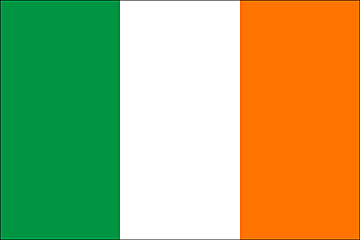

The luck of the Irish, Ireland, typically thought of fresh green beautiful farm lands and gallons of beer sitting around in pubs. Irelands flag is green, white, and orange. The color green represents the Irish culture perfectly.

China


Iraq

Iraq flag colors are red, green, and black. The design marked a notable break with the colors used in most other Arab flags, which have lengthy histories—green and black are used to represent Islam and red is used to represent Arab nationalism. Islamic crescents are usually depicted in green or red in Arab heraldry. (http://en.wikipedia.org/wiki/Flag_of_Iraq)
The crescent is commonly regarded as a symbol of Islam. The crescent was the symbol of the Sassanid Empire of Persia (Iran) and is prominently displayed on the crowns of its rulers. After the Arab conquest of that empire in 651 CE, it was gradually adopted by later caliphates and Muslim rulers as an established and recognized symbol of power ( the color red) in Western Asia. It was also a symbol of the Ottoman Empire.
The color green has a special place in Islam. It is used in the decoration of mosques, the bindings of Qur'ans, the silken covers for the graves of Sufisaints, and in the flags of various Muslim countries. Green has been associated with Islam for many centuries.


Italy
 Italy is an interesting country to look at because it's colors are associated with food. Pasta, Pizza and anything Italian come to mind with Italy. An instant thought of red, white, and green are the Italian symbol for their famous food. With roots as far back as the 4th century BCE, Italy introduction of items such as potatoes, tomatoes, bell peppers and maize. Interesting thought is red is for tomatoes, and green is for bell peppers which makes Italian food famous.

Sweden
 Sweden, the first thing that pops into peoples head when they think about this country is all the blonde hair and blue eyed people that live there. This is a very typical statement because a large amount of people are blonde hair and blue eyed. What better colors, blue and yellow, to represent their flag.


Kohlswa Herrgård
Greece
 Greece, blue and white stripes is usually associated with sailors and boating. When we look at the country, Greece, it is purely blue skies, white stackable houses and endless blue waters surrounding the country.

 In conclusion, we can see color makes up different symbolisms and reflections in cultures of all the different countries of the world. Each flag color represents something different to the country and all show a deeper reason of use and meaning of color.